A family wood-art business, from a PDF catalogue to a website with WhatsApp in place of a cart
The first website for FI Woodart, my family's business, which handcrafts layered 3D Zoroastrian wood art in Pune. Until October 2026 the whole range lived in a 51-page PDF catalogue. I designed and built a site that turns it into 203 pieces a visitor can browse by collection, wood shade, format and price, then sends whatever they pick to the makers as one ready-written WhatsApp message instead of through a checkout. It went live at fiwoodart.co.in on 15 October, a day after I started, and I have kept it up to date since.
- Client
- FI Woodart (family business)
- Role
- Designer and developer
- Year
- 2026
- Stack
- AstroTypeScriptGSAPCloudflare Pages
- Reading
- 7 min
- Live
- Visit
Context
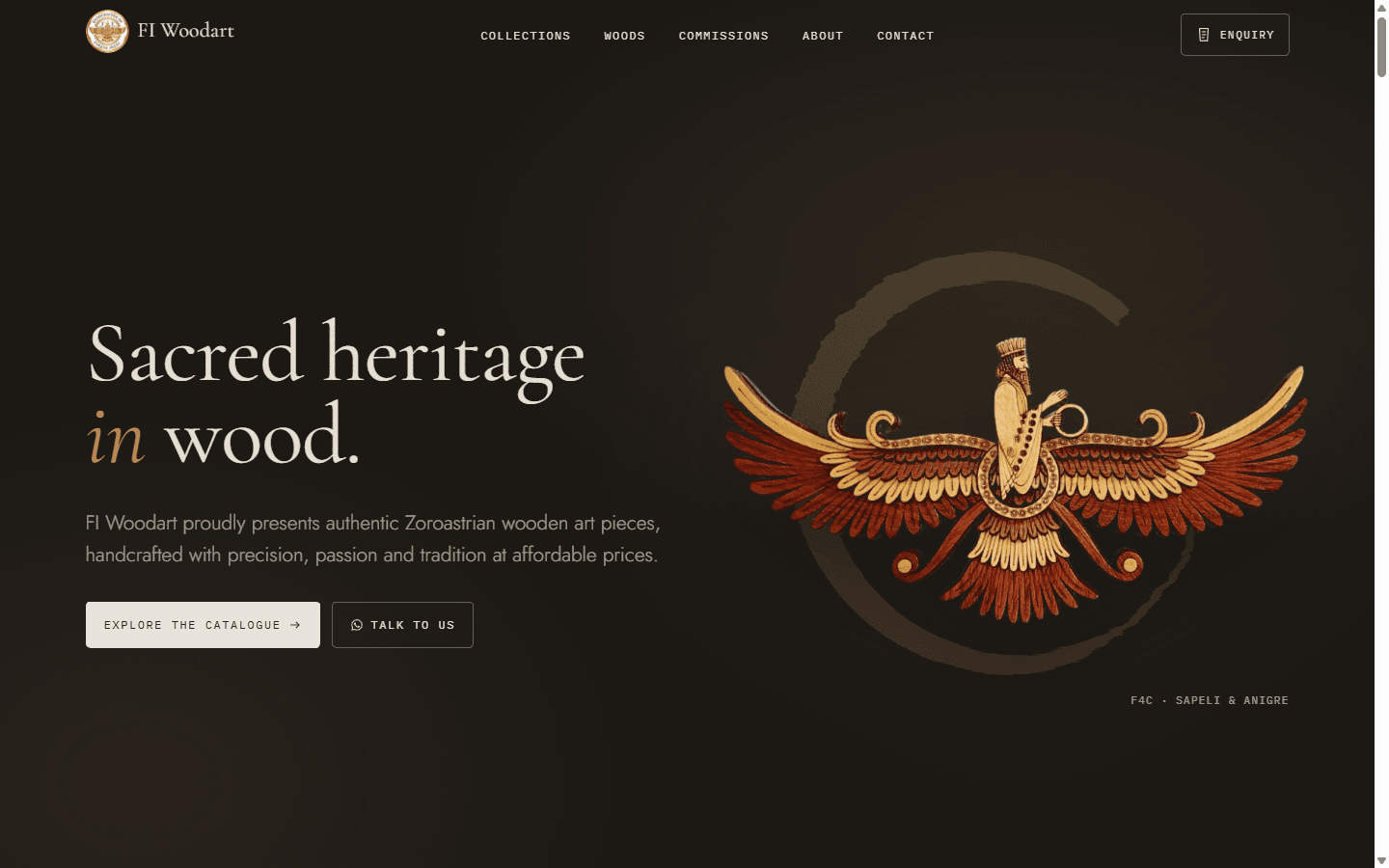
FI Woodart is my family's business. Farzad Irani handcrafts Zoroastrian art in wood: Asho Farohars, portraits of Asho Zarathushtra, the lamassus, guards and bull pillars of Persepolis, nameplates, fridge magnets and gifts. Each piece is cut from natural veneer plywood and built up in layers by hand, and its colour is only ever the wood's own, in Anigre, Sapeli, Smoked Sapeli and Teak. The range runs from a two-inch magnet to a Farohar five feet wide made for the Patel Agiary in Pune. Benafsha Irani takes enquiries alongside him.
Until now there was no website. People found FI Woodart on Instagram and Facebook, and when they asked what was available, the answer was the catalogue: a 51-page PDF of about 150 MB, with every piece shown by its code, its wood shades, and a table of sizes and prices. It is a careful document, and it is a hard thing to browse on a phone. Finding the Farohar you liked meant scrolling a long way, and asking about it meant typing the code, the shade and the size back into a chat by hand.
So I built the website the catalogue wanted to be. I designed and built it as the sole developer, working with an AI coding assistant (Claude Code). I started on 14 October 2026, and it went live at fiwoodart.co.in the next day.
The catalogue
The catalogue is the business, so I made it the spine of the site. Every piece in the PDF became its own page with its own address, and the collections, 23 of them now, became filters on a single catalogue rather than pages of their own. A visitor can tick 3D Asho Farohars, narrow it to Teak, ask for 3D rather than flat, set a starting price, and still be on the same page when they press Back. Pieces are listed in the order the catalogue uses, by code, and in natural order, so Fm9 comes before Fm10 the way a person would expect.
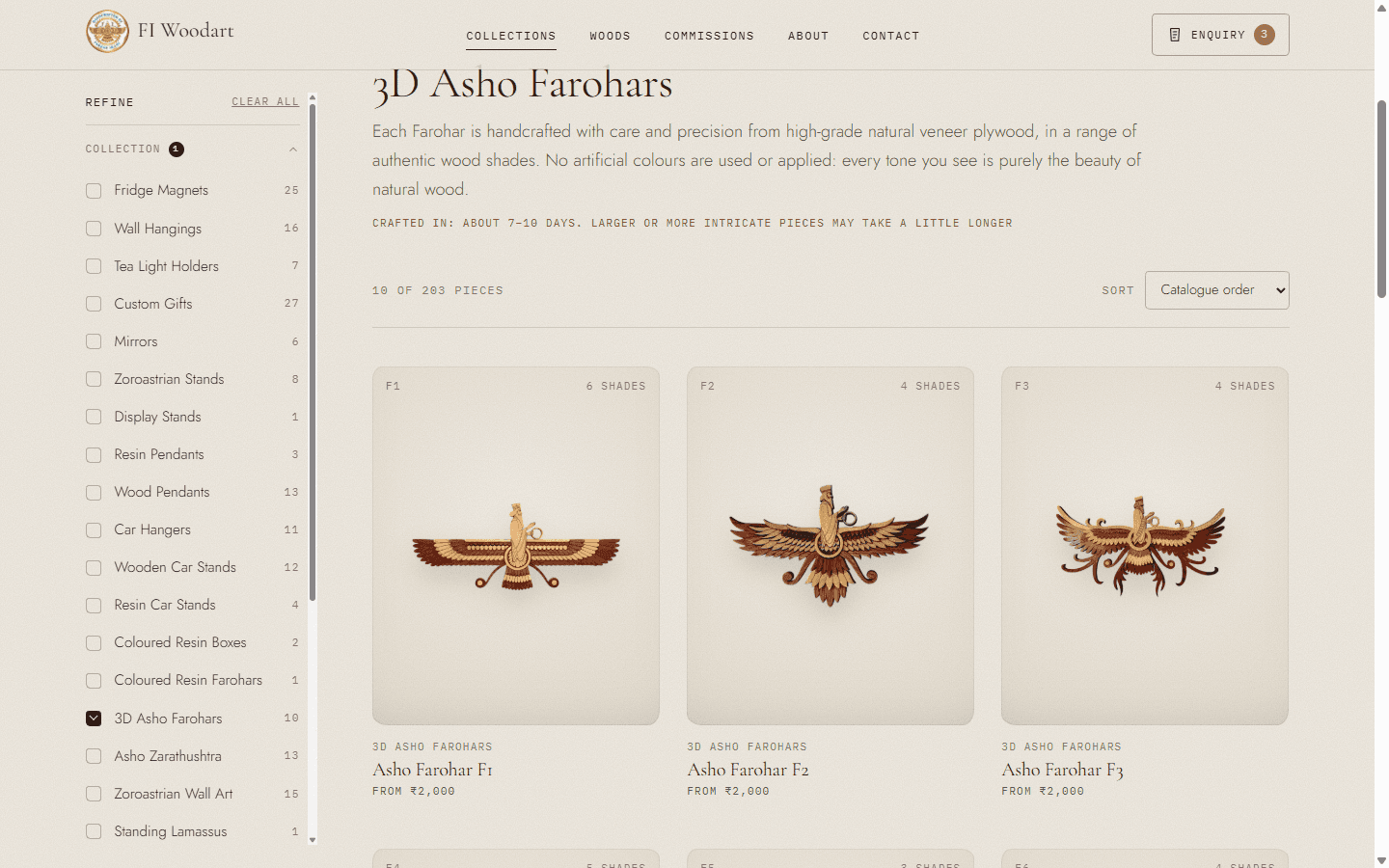
The photographs came out of the PDF itself. I extracted every image, matched each one to its piece by page and code, and cut each piece out of its background, so on the site it floats on the paper with a soft shadow beneath it, the way it would sit on a table. The photos the family has sent me since arrive on a black cloth, and they get the same treatment.
I held to one rule throughout: every fact on the site comes from the catalogue or from the family, and nothing is written to fill a gap. If the catalogue does not say what wood a piece is in, neither does the site. That rule mattered on day two, when a new edition of the catalogue arrived that gave most pieces new codes and reorganised the range from nine sections into nineteen. Every piece was checked against the new edition, every price and size along with it, and every page from the first version still answers at its old address by sending the visitor to the piece that replaced it.
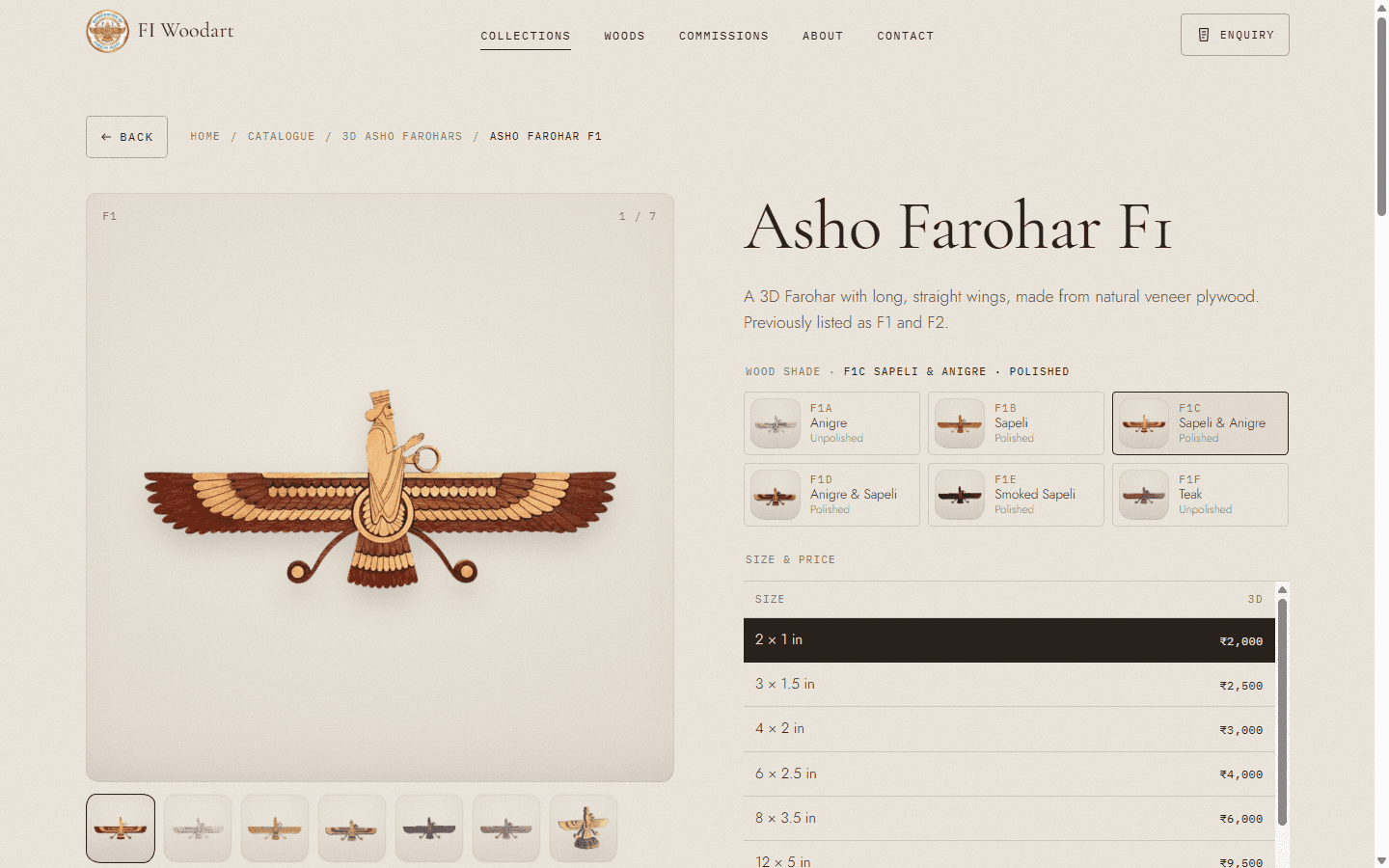
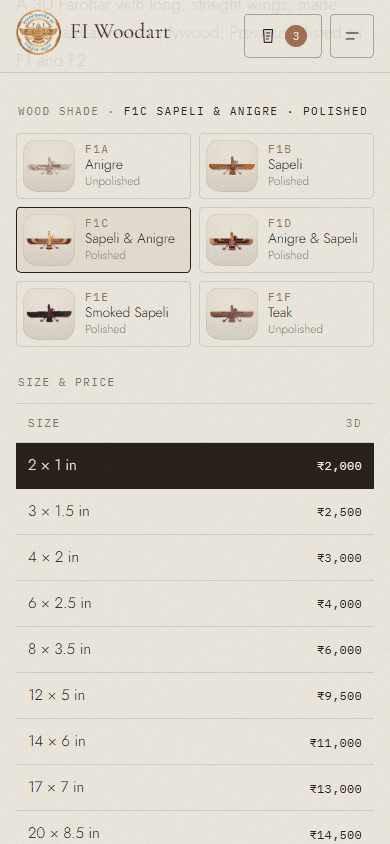
Prices were the hardest part to get right, because the catalogue prices its pieces in several different ways. A Farohar has a table of sizes, with a column for flat and another for 3D, and a few sizes made in only one of them. A display stand has a short list of sizes, each with its price. A tea-light holder has one price. Nameplates and some custom gifts are priced on request. Each piece page takes whichever shape its piece needs, alongside a swatch for every wood shade, each with its own photo.
No cart, one message
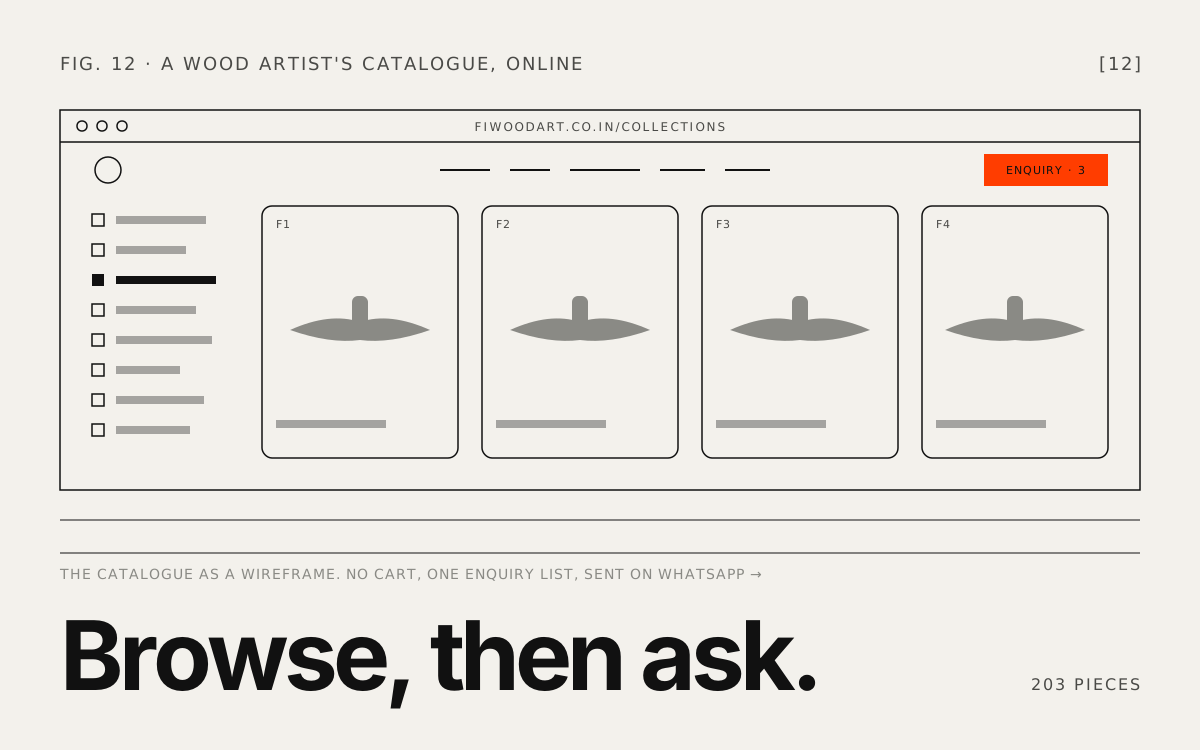
There is no checkout on the site, on purpose. These pieces are made to order, in five to six days for a magnet and seven to ten for a Farohar, and an order often needs a conversation: a name to carve, a size that is not on the list, polish, delivery to another city. That conversation already happens on WhatsApp, and a cart and payment page would have been a second way to buy that the family would then have to reconcile with the first.
So the site builds an enquiry instead of an order. A visitor picks a shade, a size and a format and adds the piece to an enquiry list, which follows them from page to page and is still there when they come back the next day. The list adds up the listed prices into an estimate and says plainly that the final quote, with shipping and polish, is confirmed on WhatsApp. There is room for a note, for the names to carve or the occasion. Then the visitor chooses who to send it to, Farzad or Benafsha, and their phone opens a WhatsApp chat with the message already written.
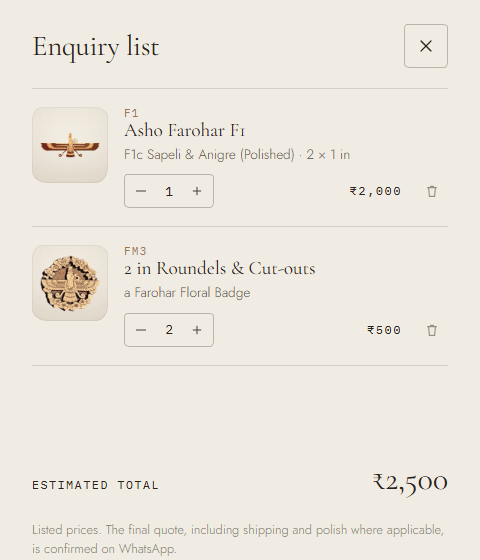
This is the message those two lines produce, exactly as it lands in Farzad's WhatsApp:
Hi Farzad! I would like to enquire about:

1. F1 · Asho Farohar F1
   Wood / design: F1c Sapeli & Anigre (Polished)
   Size: 2 × 1 in
   Qty: 1 · Listed ₹2,000 each
   https://fiwoodart.co.in/pieces/f1

2. Fm3 · 2 in Roundels & Cut-outs
   Wood / design: a Farohar Floral Badge
   Qty: 2 · Listed ₹250 each
   https://fiwoodart.co.in/pieces/fm3

Estimated total: ₹2,500

Please let me know availability and the next steps. Thank you!
It greets whoever it is going to by name, it uses the catalogue's own codes, and every line carries a link back to the piece, so the person reading it can open exactly what the customer was looking at. A customer no longer has to describe a piece, and nobody has to guess which one they meant.
The look, the speed, and being found
I wanted the site to feel like the work: warm, quiet and made by hand. The pages sit on an off-white paper with a faint grain, the home page opens on charcoal so the wood glows against it, and a brush-drawn circle sits behind the hero piece. Headings are set in Cormorant Garamond, the text in Jost, and the codes, sizes and labels in IBM Plex Mono, because the codes are how the family and their customers talk about pieces and they deserve to read as codes. Things rise gently into place as a visitor scrolls, and all of it stays still for anyone who has asked their device for reduced motion.
It is a static site, built with Astro: every page is written out as plain HTML ahead of time, so there is no server to run and nothing to patch. It is hosted on Cloudflare Pages. I first put it on Vercel, whose free plan does not allow commercial sites, so it went live on Cloudflare instead. I wrote up that move, step by step, in a guide to hosting a business site on Cloudflare Pages. Every change goes to a private copy of the site first, where the family can look it over before it reaches the public address.
Every piece page has its own title and description, written from its name and the catalogue's words, so a search for an Asho Farohar in Sapeli has a page to land on. Behind each page, search engines get a plain description of what it is: the business with its city and its two contacts, and each priced piece as a product with its price or its range of prices. The site and its sitemap are registered with Google Search Console, and the private copy tells search engines to stay away.
Since it went live
A catalogue site is never finished, and this one has changed every day since launch. Three days in, the range has grown by a set of wooden and resin car stands from their own price sheet, display stands, and a new line of resin and wood pendants. Photographs have been replaced as better ones arrived, and prices corrected as the family confirmed them.
Because the pieces keep changing, I made the site check itself. Before any release goes out it confirms that every photo a piece names exists, that no two pieces share a code, that every link still points at a piece that is there, and that every piece that was renamed or removed has its old address sent somewhere sensible. If anything fails, the release stops and the live site keeps its last good version, so a missing photograph is something I hear about rather than something a customer sees.
Want to talk? Say hello.
A project, a question, or just to compare notes. I read everything and write back within a couple of days.